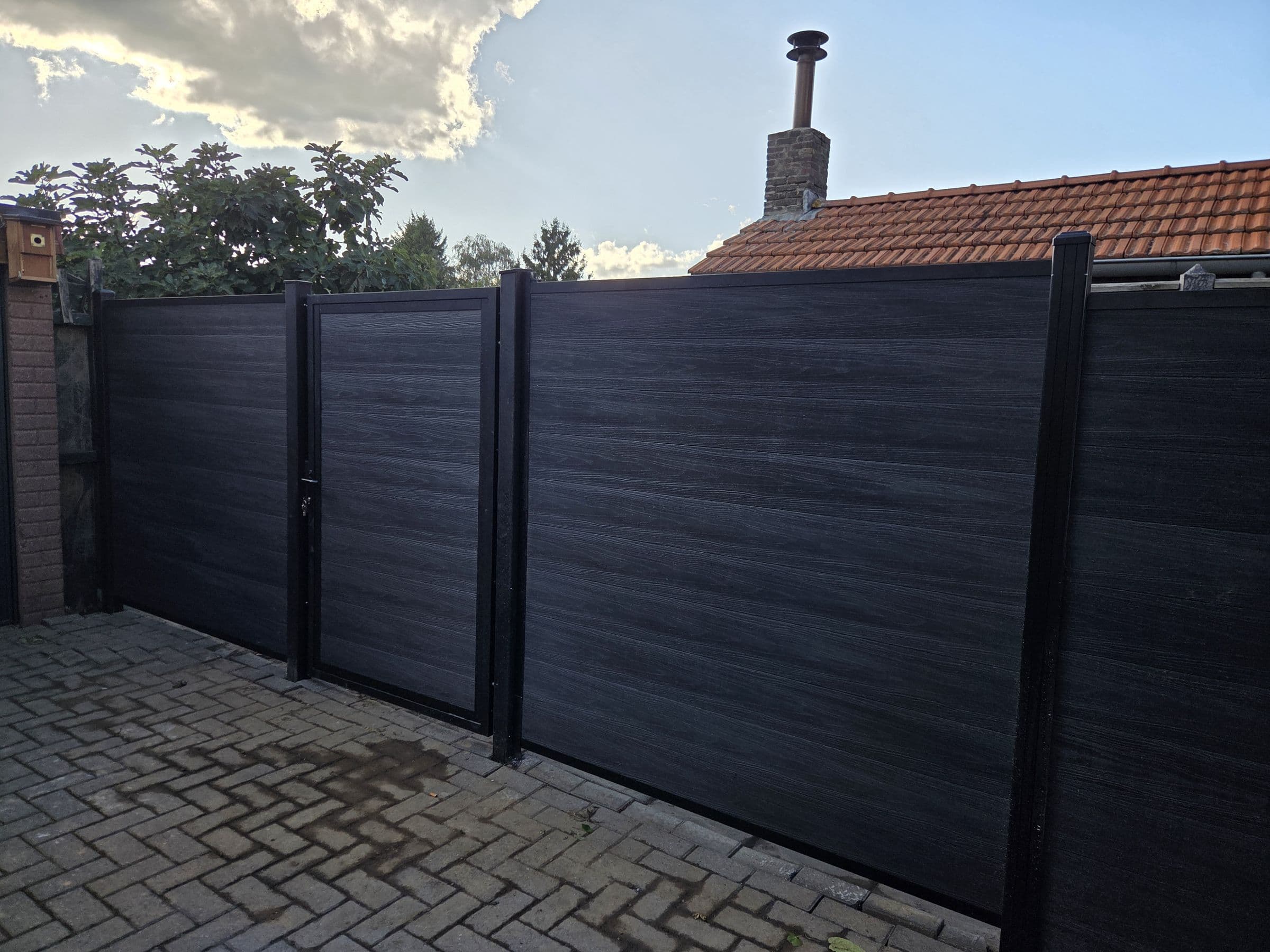
The short rule: 1 metre at the front, 2 metres at the back
A boundary fence (erfafscheiding) is anything that separates two plots: a fence, a gate, mesh fencing or a low wall. Two heights matter.
- Up to 1 metre: permit-free, wherever it stands on your plot. This is in the Besluit bouwwerken leefomgeving (Bbl, the national Buildings Decree), article 2.29 under j.
- Between 1 and 2 metres: permit-free if the fence stands behind the line along the front of the main building, on a plot that already has a main building. This rule comes from the bruidsschat (art. 22.27 under f and 22.36) and is now part of your municipality's zoning plan (omgevingsplan).
- Higher than 2 metres: never permit-free. See below.
The bruidsschat (literally ‘dowry’) is the package of national rules that was placed in every omgevingsplan when the Omgevingswet (Environment and Planning Act) took effect on 1 January 2024. A municipality (gemeente) may keep these rules, change them or drop them. So your municipality may set a different height or position from the one below.
Many internationals are used to a tall fence or hedge at the front of the house. In the Netherlands, the permit-free limit at the front is 1 metre. Check the rules before you order a taller front fence.
| Situation | Permit-free up to | Note |
|---|---|---|
| Front garden (voorerf) | 1 m | Higher usually needs a permit. |
| Side garden along a street, pavement or public green space | 1 m | Mainly relevant for corner houses. |
| Side garden next to the neighbours, behind the front of the house | 2 m | Only behind the line along the front of the main building. |
| Back garden (achtererf) | 2 m | The plot must belong to a main building. |
| Land without a main building, such as a separate vegetable plot or meadow | 1 m | The 2-metre rule only applies on a plot with a main building. |
| In, on or near a monument | Not permit-free | Not even below 1 m (art. 2.30 Bbl, art. 22.28 bruidsschat). |
| Protected national townscape or village view (rijksbeschermd stads- of dorpsgezicht) | Only behind the house | Permit-free only on the plot behind the house that does not face public space. |
| Higher than 2 m | Not permit-free | Environmental permit (omgevingsvergunning) and, for the technical part, a building notification (bouwmelding). |
Front, side and back plot explained
Your erf is the land that belongs to your house. The rules divide it into parts, measured from the front of the main building. That is usually the façade that faces the street.
- Voorerf (front plot): the land in front of the house, usually the front garden.
- Zijerf (side plot): the land beside the house. If it borders a street, pavement or public green space, the height rules treat it as the front.
- Achtererf (back plot): the land behind the house, usually the back garden.
Where the front ends and the back begins depends on the source. This is where the rules differ:
- The bruidsschat (art. 22.36) uses the line along the front of the main building itself. Since the Vangnetregeling Omgevingswet (a 2024 regulation that repaired gaps in the new law, art. 2.1b), this line runs along the front and then parallel to the adjoining public space, without passing through the house.
- For other structures, such as outbuildings, the Bbl uses the term achtererfgebied (rear plot area): the land behind a line 1 metre behind the front of the main building.
- Some municipalities use that metre for fences too. Sittard-Geleen states on its Omgevingsplein website: 1 metre in the front plot and in a side plot next to public space, and 2 metres from 1 metre behind the front façade.
A fence at a corner house
At a corner house (hoekwoning), the side plot borders the street. For a fence along that side, assume that 1 metre is permit-free and that anything higher usually needs a permit.
The reason: the bruidsschat line runs along the front of the house and then turns the corner with the side wall, parallel to the street. The strip between the side wall and the street is therefore in front of the line. The Vangnetregeling Omgevingswet clarified this in 2024.
There is also a practical reason. A tall fence on a corner can block the view of the junction or the driveway. That is why many old zoning plans (bestemmingsplannen) already kept 1 metre here, and municipalities can keep it that way in their omgevingsplan.
A fence higher than 2 metres
Above 2 metres, a boundary fence is never permit-free. Two tracks then run side by side.
- Planning: you need an environmental permit (omgevingsvergunning) for an omgevingsplanactiviteit (an activity covered by the zoning plan), unless your municipality's omgevingsplan allows the higher fence at that spot.
- Technical: a boundary fence higher than 2 metres is not technically permit-free (art. 2.26 paragraph 2 under c Bbl). For a simple structure such as a fence, the quality assurance system (kwaliteitsborging) then applies. You submit a building notification (bouwmelding) at least four weeks before work starts (art. 2.18 Bbl) and you hire an independent quality assurer (kwaliteitsborger).
- At a monument, this system does not apply. You need an environmental permit for the technical part.
Allow time for the procedure in your planning. A taller fence also catches more wind, so posts and foundations must be designed for it.
Monuments and protected townscapes
At a monument, a fence is not permit-free, not even below 1 metre. This applies in, on, attached to and near national monuments (rijksmonumenten), provincial and municipal monuments, and also provisionally protected monuments (art. 2.30 Bbl, art. 22.28 bruidsschat).
In an area marked as a protected national townscape or village view (rijksbeschermd stads- of dorpsgezicht), permit-free building is limited. It is only allowed on the plot at the back of the house, if that plot is not also at the side and does not face public space. A fence in the front garden or along a side street therefore needs a permit there.
- To see whether your building is a national monument, look it up in the Monumentenregister of the Rijksdienst voor het Cultureel Erfgoed (the national heritage agency).
- Municipal monuments are on your municipality's list of monuments (monumentenlijst).
- To see whether your address is in a protected townscape or village view, use Regels op de kaart (Rules on the map) in the Omgevingsloket, the government's online permit portal.
South Limburg has many historic buildings, such as square courtyard farms (carréboerderijen) and old houses in village centres. If you live in one, or next to one, check this before you order anything.
Permit-free does not mean rule-free
Even without a permit, every structure must meet the technical rules of the Bbl. IPLO (the government's information point for the Omgevingswet) and the national government (Rijksoverheid) both say so. For a fence, this mainly means strength: it must stand up to the wind and must not fall onto the pavement or into the neighbours' garden.
- Set the posts deep enough. As a rule of thumb, about one third of a post's length goes into the ground. Loose soil or a lot of wind may call for a concrete foundation.
- Windscreen cloth or a closed fence catches a lot of wind. Choose posts and fixings with that in mind.
- Do not build on land that belongs to the neighbours or the municipality without an agreement. Neighbour law in Book 5 of the Burgerlijk Wetboek (BW, the Dutch Civil Code) still applies. Read our guide on the property boundary.
How to check the rules for your address
The Omgevingsloket (the government's online permit portal) at omgevingswet.overheid.nl has two tools. You do not need to log in for either.
The portal is in Dutch. A translation tool in your browser helps you follow the steps. Save the result in the original Dutch as well.
- Open Regels op de kaart (Rules on the map) and enter your address. You will see which rules apply to your plot, including the municipality's omgevingsplan.
- In the omgevingsplan, look for the rules on boundary fences (erf- en perceelafscheidingen). Check the heights, the position relative to the front façade, and labels such as protected village view (beschermd dorpsgezicht).
- Then open the Vergunningcheck (permit check), enter the same address and choose building a boundary fence or fence (erfafscheiding or schutting).
- Answer the questions about position and height. The result is permit-free (vergunningvrij), a notification (melding) or a permit (vergunning).
- Save the result as a PDF or screenshot, with the date.
- If you are unsure, or if the check says something different from the omgevingsplan, email the municipality and ask for a written answer.
Rented homes and flats with a VvE
If you rent, you need permission from your landlord or housing association (woningcorporatie) for a new fence. According to the Rijksoverheid, a tenant may not change anything about the home, including the outside, unless it can be undone without much cost. Get the permission in writing, including what happens to the fence when you move out.
Many internationals in the Netherlands rent their home. Ask your landlord before you order a fence, not after.
Is the fence broken or worn? Ordinary maintenance is for the tenant. But according to the Rijksoverheid, major repairs and renewal of a fence, hedge or wall are for the landlord. So report it to your landlord first.
If you live in a flat or a house that belongs to a VvE (Vereniging van Eigenaars, the owners' association), check the splitsingsakte (deed of division) and the splitsingsreglement (its regulations). These state whether the garden is private or shared, and whether you need permission from the owners' meeting for changes to the outside.
Not sure about your situation?
Send a photo of the spot and your question on WhatsApp. We are happy to help, also if you do not know yet what you want installed.
Questions about this topic
How high can a fence be in the back garden?
In the back garden, a fence can usually be 2 metres high without a permit. The condition is that it stands behind the line along the front of the house, on a plot with a main building. This is in the bruidsschat (art. 22.27 under f and 22.36). Your municipality may have different rules in its zoning plan (omgevingsplan).
How high can a fence be in the front garden?
In the front garden, a fence or gate up to 1 metre is permit-free everywhere in the Netherlands (art. 2.29 under j Bbl). Higher is usually only allowed with an environmental permit (omgevingsvergunning). At a monument or in a protected national townscape or village view, even a low front fence is not permit-free. So always check your address.
What are the rules for a fence at a corner house?
Along the side of a corner house that borders the street, a fence up to 1 metre is permit-free. Higher usually needs a permit, because since the 2024 Vangnetregeling the bruidsschat line turns the corner with the side wall. Behind the house, the limit is usually 2 metres. Check the omgevingsplan (zoning plan).
What do I need for a fence higher than 2 metres?
Above 2 metres, a fence is never permit-free. You usually need an environmental permit for the omgevingsplanactiviteit (zoning plan activity). For the technical part, you submit a building notification (bouwmelding) at least four weeks in advance (art. 2.18 Bbl), with a quality assurer (kwaliteitsborger). At a monument, the technical part needs a permit. Ask the municipality beforehand what it expects.
SourcesBesluit bouwwerken leefomgeving (Bbl), art. 2.26, 2.29 and 2.30 (in Dutch)
Can I put up a fence if I rent my home?
Only with permission from your landlord or housing association (woningcorporatie). According to the Rijksoverheid, a tenant may not change anything about the home, including the outside, except things that can be undone without much cost. Get the permission in writing. According to the Rijksoverheid, renewing an existing fence is usually at the landlord's expense.
SourcesRijksoverheid: may I renovate my rented home? (in Dutch)
Where can I see which rules apply to my address?
In the Omgevingsloket at omgevingswet.overheid.nl. In Regels op de kaart (Rules on the map), you enter your address and see your municipality's zoning plan. The Vergunningcheck (permit check) asks about position and height and tells you whether you need a permit. You do not need to log in. The site is in Dutch. If in doubt, ask the municipality for a written answer.
SourcesOmgevingsloket: Vergunningcheck and Regels op de kaart (in Dutch)
Sources
- IPLO: permit-free boundary fences (in Dutch)iplo.nl
- Besluit bouwwerken leefomgeving (Bbl), art. 2.26, 2.29 and 2.30 (in Dutch)wetten.overheid.nl
- Omgevingsloket: Vergunningcheck and Regels op de kaart (in Dutch)omgevingswet.overheid.nl
- Rijksoverheid: building and renovating without a permit (in Dutch)rijksoverheid.nl
- Rijksoverheid: may I renovate my rented home? (in Dutch)rijksoverheid.nl
- Rijksoverheid: which costs are for the tenant and which for the landlord (in Dutch)rijksoverheid.nl
- Omgevingsplein Sittard-Geleen: how high can my boundary fence be? (in Dutch)omgevingsplein.sittard-geleen.nl
Last checked: 5 October 2026