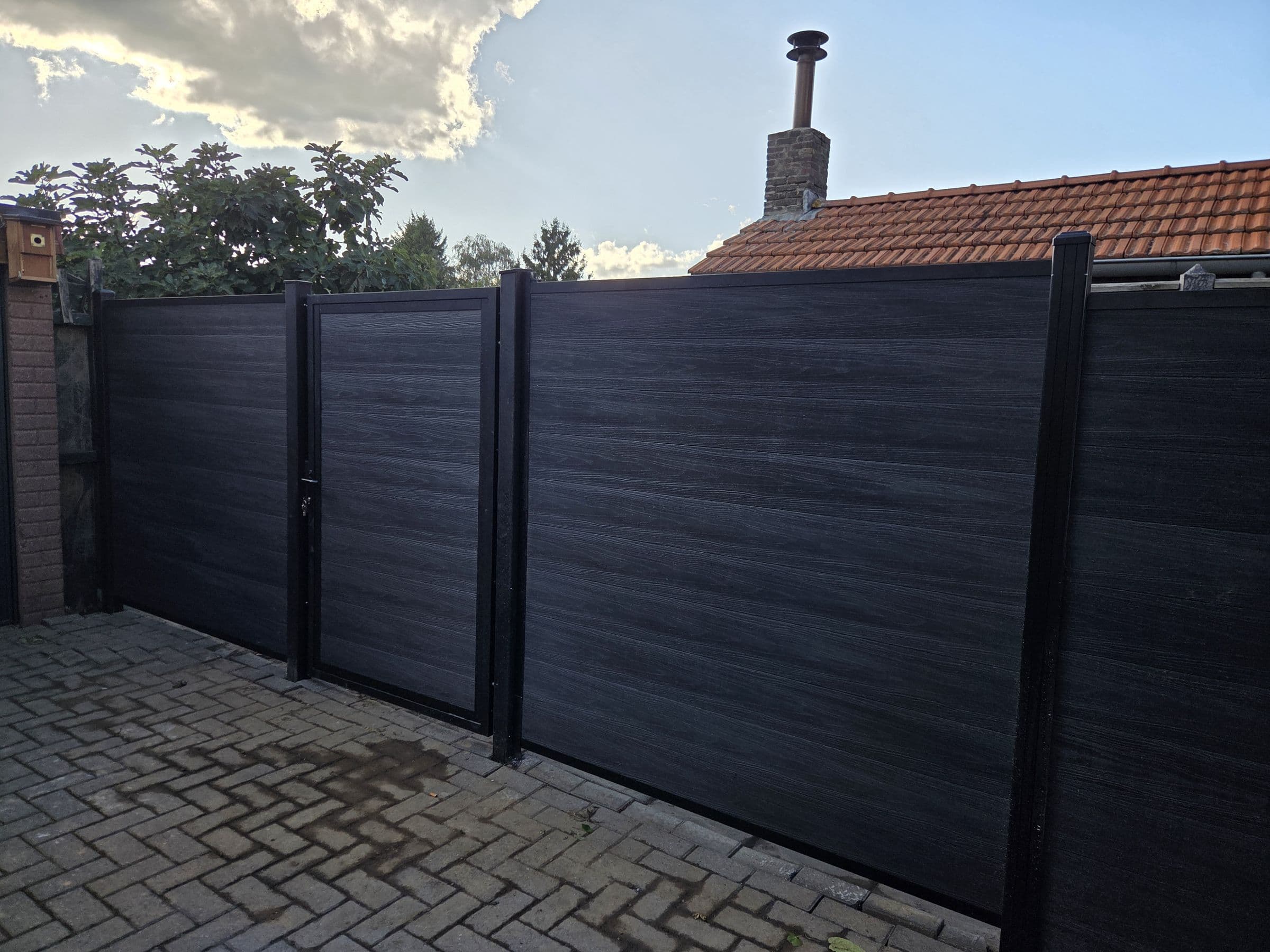
On the boundary or on your own land
The first choice is where the fence goes. That decides who owns it, who decides and who pays. In the Netherlands, these rules come from Book 5 of the Burgerlijk Wetboek (BW, the Dutch Civil Code). They may differ from what you know from your home country.
| Topic | On the boundary | Entirely on your own land |
|---|---|---|
| Owner | You and your neighbours together (mandelig, jointly owned, art. 5:62 BW) | You alone |
| Neighbours' consent | Needed: the fence partly stands on their land | Not needed to put it up |
| Cost of installation | To be agreed between you | Yours |
| Maintenance and renewal | At the expense of both owners (art. 5:65 BW) | Yours |
| Material, colour and height | Decided together | You decide, within the rules of the omgevingsplan |
If you choose your own land, set the fence a few centimetres inside the boundary. Then the posts, the foundations and the gravel boards also stay on your land. A gravel board (onderplaat) is the concrete board at the bottom of the fence, between the posts.
Joint ownership: what mandelig means
The law says: a free-standing dividing wall, a fence or a hedge is jointly owned and mandelig if the boundary between two plots runs lengthwise underneath it (art. 5:62 BW). In plain words: the fence belongs to both of you.
- Maintenance, cleaning and, if needed, renewal are at the expense of all owners (art. 5:65 BW).
- Replacing it, making it higher, changing the material or removing it: you decide this together.
- If the fence blows down, repairing it is a joint matter.
If you cannot agree, neighbourhood mediation (buurtbemiddeling) or the Juridisch Loket (a free legal advice service) can help before it becomes a court case.
Who pays: article 5:49 BW
In a built-up part of a municipality (aaneengebouwd gedeelte), so in a built-up neighbourhood, every owner can demand that the neighbour cooperates on a dividing wall (scheidsmuur) 2 metres high on the boundary. The owners share the costs equally (art. 5:49 paragraph 1 BW).
The law literally speaks of a dividing wall. If there is a dispute, a court decides how this applies to a fence.
- The article does not apply if one of the two plots is itself a public road or public water (paragraph 2). So along the pavement or a municipal ditch, you cannot make the municipality pay a share.
- Outside a built-up area, for example at a detached house in the countryside, it usually does not apply.
- If a local regulation (verordening) or local custom sets a different type or height of partition, that takes priority. Under the law, the costs are still shared equally.
- The article is about a 2-metre partition on the boundary. If you want a more expensive design, agree in advance who pays the extra cost.
A legal claim is a last step. A conversation and a short written agreement are almost always faster and cheaper.
Where exactly the boundary lies
The boundary you see in the garden is not always the legal boundary. The Kadaster (the Dutch Land Registry) makes this distinction:
- Gebruiksgrens (boundary in use): the boundary as it is used in practice, for example along the old fence or hedge.
- Kadastrale grens (cadastral boundary): the boundary as the Kadaster recorded it when the plot was created.
According to the Kadaster, the boundary in use sometimes shifts. For example, someone once put up a fence that did not follow the legal boundary exactly. If you replace such a fence, that is the moment to put it right.
- Look at the cadastral map or the ownership information for your plot at the Kadaster. The map gives an impression; for an exact line on the ground, a survey is needed.
- Look for fixed points: boundary stones, old posts or the corner of a building. Discuss with your neighbours what you both see as the boundary.
- If you and your neighbours agree on a boundary in use that differs, you can have it recorded as the new cadastral boundary. The Kadaster calls this grenscorrectie (boundary correction). It is possible if both parties agree and the strip is no larger than 100 m².
- If you are unsure, or if you disagree, apply for a grensreconstructie (boundary reconstruction). A Kadaster surveyor (landmeter) then marks the existing cadastral boundary on the ground again.
Putting agreements with your neighbours in writing
Write agreements down, even if you get on well with your neighbours. Houses are sold and memories shift. A short, signed agreement prevents arguments later. Include the following:
- Where the fence goes: on the boundary, or on whose land and how many centimetres from it. Add a sketch with measurements from fixed points, such as a façade.
- Material, colour and height, and which side faces whom.
- Who pays for what: installation, removing the old fence and later maintenance.
- Who places the order with the installer and who signs the quote.
- That work may take place on both sides on the day of installation, and what happens to plants along the boundary.
- What you do in case of damage, for example after a storm.
- Date, names, addresses and the signatures of all owners.
If you and your neighbours do not share a first language, write the agreement in simple Dutch, or in Dutch and English. Everyone should understand what they sign.
Digging and cables: the KLIC notification
Fence posts need digging or drilling. Cables and pipes may lie in gardens. A KLIC notification (KLIC-melding) to the Kadaster shows which cables and pipes network operators have in the area.
- If you dig with an excavator, the Kadaster says you must make a KLIC notification beforehand.
- Digging by hand does not require a notification. But you can still hit a cable or pipe with a hand auger. The Kadaster therefore advises making a notification then too.
- An earth auger (grondboor) is a drill for post holes, operated by hand or with a motor. If you are unsure whether a tool counts as a machine, make the notification.
Tell the installer beforehand what you know about pipes in the garden, such as a rainwater drain, drainage or garden lighting. These are not always on a KLIC drawing.
What we need to know about the boundary before we start
We set out every line with a tensioned string line and a laser. That only works if it is clear where the line must go. Before we start, we need to know:
- Whether the fence goes on the boundary or on your own land, and if so, how many centimetres inside the boundary.
- Whether your neighbours agree, and for a fence on the boundary, who places the order.
- Which points mark the start and the end: a boundary stone, the corner of a façade or an existing post.
- Whether the old fence must be removed, and who owns it.
- Whether we need to work from the neighbours' side, and whether that is allowed.
- What you know about cables, pipes and drainage along the line.
We do not establish the boundary. You and your neighbours do that, or the Kadaster. We put the fence exactly on the line you point out together.
Not sure about your situation?
Send a photo of the spot and your question on WhatsApp. We are happy to help, also if you do not know yet what you want installed.
Questions about this topic
Who pays for a fence on the property boundary?
A fence on the property boundary (erfgrens) belongs to both neighbours together (art. 5:62 BW). Maintenance and renewal are at the expense of both owners (art. 5:65 BW). For a new fence, you agree the split together. If you want to decide and pay alone, put the fence entirely on your own land.
SourcesDutch Civil Code (BW) Book 5, art. 5:65: maintenance of jointly owned property (in Dutch)
Can my neighbour put a fence on the boundary without my consent?
No. A fence on the boundary partly stands on your land and becomes jointly owned (art. 5:62 BW). That needs your consent. If your neighbour puts the fence entirely on their own land, they do not need consent, as long as they follow the height rules in the omgevingsplan (zoning plan).
SourcesDutch Civil Code (BW) Book 5, art. 5:62: jointly owned boundary fence (in Dutch)
Can I replace a shared fence without my neighbours?
Not just like that. A jointly owned (mandelig) fence belongs to both of you, and renewal is at the expense of both owners (art. 5:65 BW). Discuss material, height and cost first, and put it in writing. If you want to decide yourself, put the new fence on your own land and agree what happens to the old one.
SourcesDutch Civil Code (BW) Book 5, art. 5:65: maintenance of jointly owned property (in Dutch)
Can I make my neighbour pay a share?
In a built-up part of a municipality, art. 5:49 BW lets you demand that your neighbour cooperates on a 2-metre dividing wall on the boundary, with the costs shared equally. This does not apply if one of the plots is a public road or public water. The law speaks of a dividing wall (scheidsmuur); in a dispute, a court decides.
SourcesDutch Civil Code (BW) Book 5, art. 5:49: dividing wall (in Dutch)
How do I know exactly where the property boundary is?
The boundary you see, the boundary in use, sometimes differs from the cadastral boundary. Start with the cadastral map and fixed points such as boundary stones. If in doubt, a Kadaster surveyor marks the recorded boundary on the ground with a boundary reconstruction (grensreconstructie). If you disagree about that boundary, according to the Kadaster only a court decides.
Do I need a KLIC notification for fence posts?
If you dig with an excavator, a KLIC notification (KLIC-melding) to the Kadaster is required. Digging by hand does not require one, but you can still hit cables and pipes with a hand auger. The Kadaster therefore advises a notification then too. Also tell the installer what you know about pipes and drainage.
SourcesKadaster: digging and the KLIC notification (in Dutch)
Sources
- Dutch Civil Code (BW) Book 5, art. 5:49: dividing wall (in Dutch)wetten.overheid.nl
- Dutch Civil Code (BW) Book 5, art. 5:62: jointly owned boundary fence (in Dutch)wetten.overheid.nl
- Dutch Civil Code (BW) Book 5, art. 5:65: maintenance of jointly owned property (in Dutch)wetten.overheid.nl
- Kadaster: cadastral boundary and boundary in use (in Dutch)kadaster.nl
- Kadaster: boundary reconstruction (in Dutch)kadaster.nl
- Kadaster: digging and the KLIC notification (in Dutch)kadaster.nl
- IPLO: permit-free boundary fences (in Dutch)iplo.nl
Last checked: 5 October 2026