Concrete gravel boards and footings for your fence
A concrete gravel board (onderplaat) sits at the bottom of the fence, between the posts, partly in the ground. It keeps the boards out of the wet soil and the earth on your side. ZuidHek installs gravel boards and concrete footings in South Limburg, with every line set out with a string line and a laser.
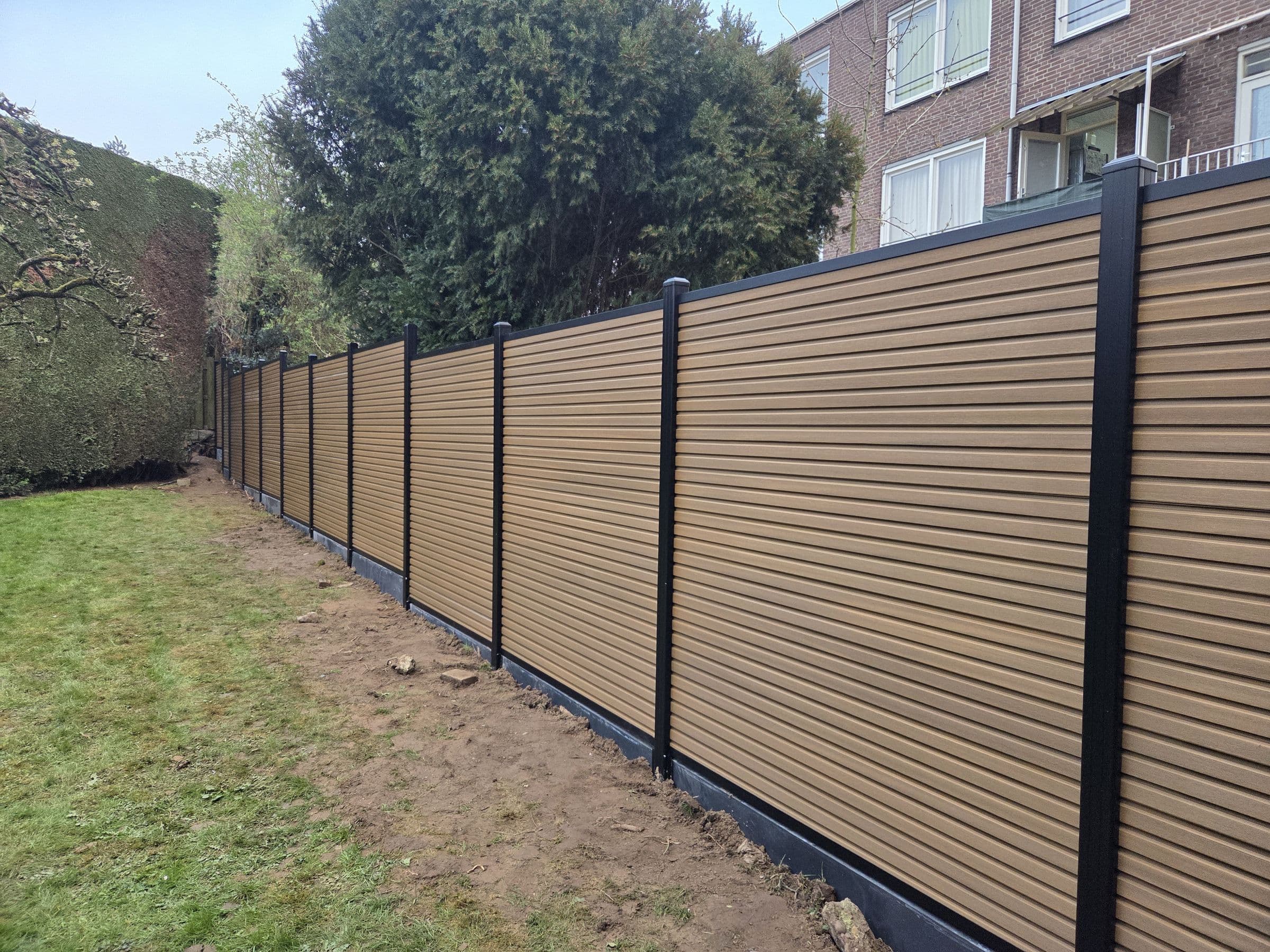
With a fence, you see the boards. Whether it still stands straight in ten years depends on what you do not see: how deep the posts are, what they stand in and how the bottom is built. A 2 m fence catches a lot of wind in a storm, and that force goes through the posts into the ground.
That is why we set posts about one third of their length into the ground, about 70 to 80 cm for a 2 m fence. In loose or wet soil, in an open spot or for a heavy gate, we go deeper or pour a concrete footing. The soil in Limburg varies, with loess or clay in many places. What you have only becomes clear when the auger goes in.
If your garden is higher or lower than the neighbours', the gravel board also holds back the soil. If there is an old foundation or concrete footing in the ground, we break it out and take away the rubble, so the new fence starts on a clean line.
Specifications
- Gravel board
- Concrete board between the posts, a few centimetres into the ground. Smooth or with a pattern, in grey or anthracite.
- Post depth
- About one third of the post length. For a 2 m fence about 70 to 80 cm.
- Precast footing
- Precast concrete base that a post stands in or on. Quick to install, for lighter structures.
- Concrete footing
- Poured concrete around the post or as a continuous strip, for heavy loads, soft ground, gate posts or windscreen cloth.
- Soil
- Sand, loess and clay each behave differently. We adjust the depth to what comes out of the hole.
- Height difference
- A gravel board holds back a small height difference. For more, a gravel board alone is not enough.
- Old foundation
- We break out old concrete bases, posts and gravel boards and take them away.
- Gravel board between the posts
- The standard build under a composite fence: the board in the slot of the post, a few centimetres into the ground.
- Precast footing
- Precast base for lighter structures or places where digging deep is difficult.
- Poured footing
- Concrete around the post or as a continuous strip, for tall fences, gate posts, windscreen cloth or soft ground.
- Removing the old foundation
- Old concrete posts, bases and gravel boards out and the rubble taken away, so we can start on a clean line.
How we install it
- 1
Cables and setting out
First we check where cables and pipes are. Then we set out the line with a string line and a laser.
- 2
Old out
We break out old posts, concrete bases and gravel boards. We take away what comes out.
- 3
Drilling the holes
With the auger, to the right depth. What comes out of the hole tells us if we need to go deeper or pour concrete.
- 4
Posts and gravel boards
Posts in concrete, level and at laser height. Then the gravel boards go in between, so the bottom edge is the same everywhere or steps down evenly if the garden slopes.
Projects: Gravel boards and footings
All projectsLong wood-effect composite fence, set out in one straight lineComposite, wood-effect · Mar 2026 Wood-effect fence along the full length of the gardenComposite, wood-effect · Mar 2026 Posts set out and in place, ready for the boardsWork in progress · May 2026 Anthracite fence stepped to follow a slopeComposite, anthracite · Jun 2026 Wood-effect fence on the boundary with a meadowComposite, wood-effect · Jul 2026 Anthracite boards going in between the postsWork in progress · May 2026
Good to know
- Post depth is not a guess
- The rule of thumb is about one third of the post length in the ground. In wet clay, loose soil or an open, windy spot, that is the minimum. A post that is too shallow leans after the first heavy storm.
- Report digging through KLIC
- If you dig with a machine, a KLIC notification to the Kadaster is required. It shows where cables and pipes are. With a spade or hand auger it is not required, but the Kadaster still advises it. Hitting a cable costs more time and money than a notification.
- A gravel board is not a retaining wall
- A gravel board holds back a small height difference. If your garden is much higher than the neighbours', the wet soil pushes the board out of line after a few winters. Discuss it beforehand, also with the neighbours.
Further reading
Frequently asked questions
How deep should fence posts go into the ground?
The rule of thumb is about one third of the post length. For a 2 m fence that means about 70 to 80 cm in the ground. In loose or wet soil, in a windy spot, with windscreen cloth or for gate posts, we go deeper or set the post in a concrete footing.
Why does a fence need a gravel board?
A concrete gravel board keeps the boards out of the damp soil, so they stay dry and clean at the bottom. It holds back earth where there is a small height difference and gives the fence a straight bottom edge. The board sits a few centimetres into the ground, between the posts.
Do I need a KLIC notification for a fence?
If you dig with an excavator, a KLIC notification to the Kadaster is required. If you dig by hand, it is not. The Kadaster does advise a notification when you use a hand auger too, because cables and pipes are sometimes less deep than you expect.
Can you remove old concrete posts and foundations?
Yes. We break out old concrete posts, concrete bases and gravel boards and take away the rubble. Sometimes an old base can stay if it is not in the way, but usually it is exactly where the new post must go. We see this when we set out the new line.
Want us to look at your situation?
Send a few photos and the rough length on WhatsApp. You get a quote for your garden, free and with no obligation.
Your messageZuidHek · +31 6 13 87 10 16
Hi ZuidHek, I would like a quote for gravel boards and footings. I'll send a few photos of the garden next.
When WhatsApp opens, send 2 or 3 photos of the situation. This helps us make a faster and more accurate quote.
This website does not store anything. Your message goes straight to WhatsApp.