Chain-link fencing, installed in Dutch Limburg
Chain-link fencing (gaashekwerk) is wire mesh from a roll. It hangs between posts on tight tension wires. It is an affordable way to fence long runs, such as a meadow, a vegetable garden or the back of a deep plot. ZuidHek installs it tight and straight with a string line and a laser, across South Limburg.
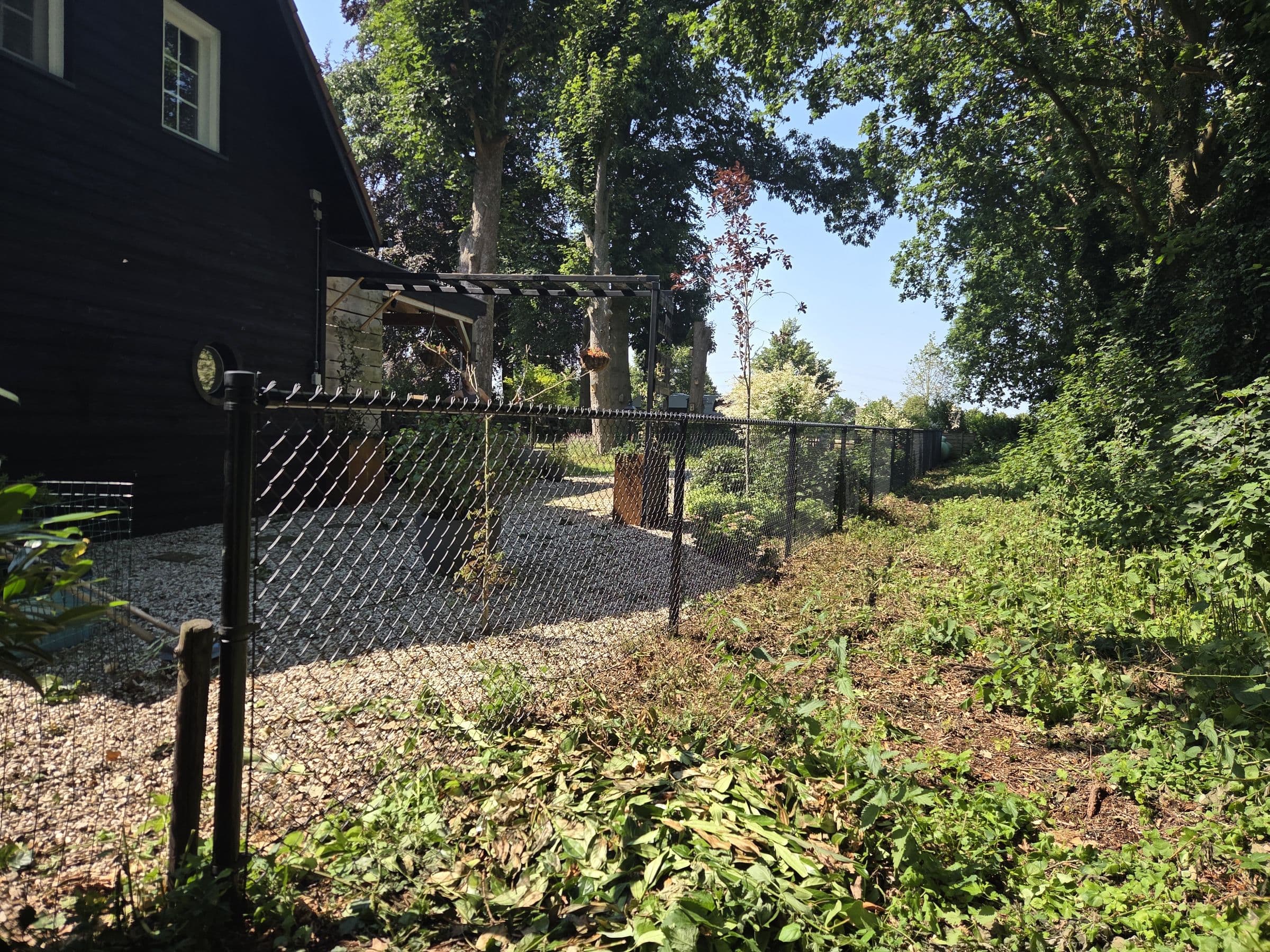
Chain-link is the logical choice where you need many metres and no privacy: a meadow with horses or sheep, a vegetable garden, the back boundary of a deep garden or a run for the dog. The fence is light, lets everything through and is hardly visible among the plants.
The difference between a neat chain-link fence and a slack one is in the tensioning. Chain-link has no stiffness of its own. That comes from the tension wires at the top, middle and bottom, which we pull tight between corner and end posts with a brace. Only then do we tie the mesh to them.
If you want more strength or a cleaner look, for example on the street side, look at twin wire mesh. At the back of the garden or along a meadow, chain-link is often all you need.
Specifications
- Mesh
- Woven wire mesh on a roll, galvanised and usually coated in green or black. Common mesh size 50×50 mm.
- Posts
- Steel posts in the same colour. Corner and end posts get a brace post that takes the tension.
- Tension wire
- Two or three tight wires along the whole length, pulled tight with wire tensioners.
- Tie wire
- Thin wire that fixes the mesh to the tension wires and posts.
- Height
- Usually from about 1 m to 2 m.
- Post depth
- About one third of the post length in the ground. Corner and end posts go in concrete, because they carry the tension.
- Green coated
- The least visible between hedge and grass. Common along meadows and at the back of the garden.
- Black coated
- Calmer in a modern garden and matches anthracite or black metal elsewhere in the garden.
- With pedestrian gate
- A simple gate in the same colour, so you can get in with a wheelbarrow or lawnmower.
How we install it
- 1
Setting out
A tight string line along the run and the laser for the height. On a long line every wobble shows in the mesh, so the posts must stand in one straight line.
- 2
Corner and end posts
Corner and end posts go in concrete, with a brace that takes the tension. Line posts at regular distances, usually every 2.5 to 3 m.
- 3
Tensioning the wire
Tension wires at the top, middle and bottom along the whole length, pulled tight with wire tensioners.
- 4
Hanging the mesh
We unroll the mesh, fix it at one end, pull it tight and tie it to the tension wires and posts with tie wire.
Projects: Chain-link fencing
All projectsChain-link fence between the plantsChain-link · Jun 2026
Good to know
- Tensioning is everything
- Slack mesh bulges and sags further after a winter. It must be tight, and that only works if the corner and end posts do not move. That is why we set them in concrete, with a brace.
- No privacy, little resistance
- Chain-link keeps animals and people out, but not eyes. A hedge next to it grows through and forms a green wall after a few years. Do not hang cloth on it: the mesh and thin posts are not made for that.
- Small animals crawl under
- Rabbits and small dogs soon find a gap at the bottom. Make sure the mesh sits close to the ground or bury the bottom edge a little. Mention it in your quote request if this matters to you.
Further reading
Frequently asked questions
What is the difference between chain-link and twin wire mesh?
Chain-link is wire mesh from a roll that gets its strength from tight tension wires. It is light and affordable for long runs. Twin wire mesh is made of stiff, welded panels and is stronger and neater, but also more expensive. For a meadow or back boundary, chain-link is often enough. On the street side many people choose twin wire mesh.
How does chain-link fencing stay tight?
With well-tensioned wires and corner posts that do not move. The tension wires are pulled tight with wire tensioners between corner and end posts, which stand in concrete with a brace. The mesh hangs on those wires with tie wire. If the fence starts to sag after some time, the tensioners can often be turned a little tighter.
Is chain-link suitable for a meadow or vegetable garden?
Yes, that is exactly what it is for. Chain-link closes off long runs without blocking the view. For horses or other large animals, choose taller mesh and heavier posts. For a vegetable garden about 1 m is often enough. To keep rabbits out, bury the bottom edge a little.
Do I need a permit for chain-link fencing?
Chain-link follows the same rules as any boundary fence. Up to 1 m high it is usually permit-free. Up to 2 m usually too, on a plot with a main building and behind the front of the house. For a meadow without a house, on the street side or at a listed building, the rules are different. Check them in the Omgevingsloket.
Want us to look at your situation?
Send a few photos and the rough length on WhatsApp. You get a quote for your garden, free and with no obligation.
Your messageZuidHek · +31 6 13 87 10 16
Hi ZuidHek, I would like a quote for chain-link fencing. I'll send a few photos of the garden next.
When WhatsApp opens, send 2 or 3 photos of the situation. This helps us make a faster and more accurate quote.
This website does not store anything. Your message goes straight to WhatsApp.