Frequently asked questions about fences
The questions we get most often, with the source. Last checked: 5 October 2026. Rules differ per municipality and per address, so if in doubt, always use the permit check (Vergunningcheck). This is not legal advice.
Rules and permits
Do I need a permit for a fence in the Netherlands?
A boundary fence up to 1 m high is usually permit-free (art. 2.29 of the national building rules, Bbl). Up to 2 m is usually also allowed without a permit, if the fence is behind the front of the house on a plot with a main building. Stricter rules apply to listed buildings and protected townscapes. Use the permit check for your address.
How high can a fence be in the back garden?
Usually 2 m without a permit. This comes from the standard rules that every municipality started with (bruidsschat, art. 22.36): the fence must be behind the line along the front of the main building. Your municipality can change this in its local plan (omgevingsplan). For anything higher than 2 m you need an environmental permit (omgevingsvergunning). Check your address first.
How high can a fence be in the front garden?
In the front garden, and in a side garden next to a public road, a boundary fence up to 1 m is allowed without a permit. Higher usually needs a permit. In Sittard-Geleen the rule is: up to 1 m in the front garden and up to 2 m from 1 m behind the front of the house. Other municipalities can have different rules, so check your own local plan.
SourcesOmgevingsplein Sittard-Geleen: permit check (in Dutch)
What is the difference between the front and the back garden?
Under the Bbl, the back garden area starts 1 m behind the front of the main building. The standard rule for boundary fences (bruidsschat) uses the line along the front itself. So the two sources differ on exactly that first metre. If you are unsure, look at your municipality's local plan or use the permit check for your address.
What applies to a corner house?
With a corner house, the side garden borders the street. The same rule as at the front usually applies there: up to 1 m without a permit. Where that limit is exactly and how far back it runs depends on the situation and the local plan. To be sure, use the permit check and send us a photo of the garden.
What if I want a fence higher than 2 metres?
Then you need a permit for the planning side, and a building notification (bouwmelding) for the technical side (art. 2.18 Bbl). Up to 2 m a boundary fence is technically permit-free (art. 2.26 Bbl), but the technical rules in the Bbl still apply. Arrange the permit before we start, not afterwards.
Can I put up a fence at a listed building?
At a national monument (rijksmonument) and in a protected townscape, a boundary fence is not permit-free (art. 2.30 Bbl and art. 22.28 of the standard rules). Even a low fence may then need a permit. In Limburg this applies, for example, in historic centres such as Maastricht and Valkenburg. Ask the municipality first.
Where do I check the rules for my address?
In the national Omgevingsloket on omgevingswet.overheid.nl. The permit check (Vergunningcheck) asks about your plan step by step and shows whether you need a permit or a notification. With Regels op de kaart (rules on the map) you can see the local plan for your plot. The website is in Dutch, so you may want to use your browser's translate function.Sittard-Geleen also has its own Omgevingsplein with explanations and a link to the check.
Boundary and neighbours
Does my neighbour have to share the cost of a fence?
Sometimes. Under Dutch civil law (art. 5:49 BW), in a built-up part of a town or village you can ask your neighbour to cooperate on a dividing wall of up to 2 m on the boundary. The costs of building and maintaining it are then shared equally. A local regulation or custom can only change how it is built and how high it is. This does not apply along a public road or public water.
Do I need permission from my neighbours?
If the fence goes on the property boundary (erfgrens), it usually becomes jointly owned by you both (mandelig). So talk first and agree how to share the costs. If you put it fully on your own land, you need no permission and you pay yourself. Talking is still wise, because a fence stays for years. If you rent, you need written permission from your landlord or housing corporation (woningcorporatie). If you own an apartment, check with your owners' association (VvE) whether the garden is private or shared.
How do I know exactly where the boundary is?
The boundary you use, such as an old hedge or fence, is not always the official land registry boundary. If you are unsure, a surveyor from the Kadaster (Land Registry) can mark the boundary on site with a boundary reconstruction. Have that done before we set out the line. Moving a fence costs more than measuring first.
SourcesKadaster: registered boundary and boundary in use (in Dutch)
Do I need a KLIC notification to install fence posts?
If you dig with an excavator, a KLIC notification is required. It tells you where cables and pipes are underground. If you dig by hand, you do not have to report it, but the Kadaster advises a notification when you use a hand auger. Then you know where cables and pipes are before the first post goes in.
Materials
Composite, wood, wood and concrete, or twin wire mesh: what suits my garden?
Composite gives a solid screen and needs little maintenance. Wood is cheaper to buy, but needs treatment every few years. Wood and concrete fences are heavy and strong, but we do not install them ourselves. Twin wire mesh is open and strong and suits front gardens and larger sites. Choose based on privacy, maintenance and where the fence goes.
Is a composite fence maintenance-free?
Low-maintenance is the right word. Composite does not need stain, oil or paint. Rinsing it now and then with water and a soft brush keeps the boards clean. A wooden fence needs regular treatment. Boards with co-extrusion, an extra protective layer around the core, take up less dirt and moisture.
What are the disadvantages of composite?
Composite expands in heat: about 1 mm per metre for a 40 °C temperature difference, so we install it with room to move. Dark colours such as anthracite get hot in the sun. Composite costs more than wood, and a damaged board is harder to repair. Co-extrusion gives better protection against moisture, dirt and UV.
What does 6/5/6 or 8/6/8 mean for twin wire mesh?
These are the wire thicknesses in millimetres: horizontal, vertical, horizontal. An 8/6/8 panel is heavier and stiffer than 6/5/6. For a normal garden 6/5/6 is usually enough. Choose 8/6/8 for a business site or if windscreen cloth will be added. The mesh openings are usually 200×50 mm.
Chain-link or twin wire mesh?
Chain-link comes on a roll, is light and affordable, and stays straight if it is properly tensioned with tension wire. Twin wire mesh is made of stiff welded panels: stronger, straighter in the line and more expensive. For a long boundary along a meadow or vegetable garden, chain-link is often enough. For a front garden or driveway, where the fence takes more knocks, twin wire mesh is the better fit.
Can windscreen cloth go on twin wire mesh?
Yes. But with cloth the fence catches much more wind. Posts, fixings and footings must be designed for that, especially in an open spot. Tell us beforehand, and we choose the posts and depth to match. We advise against hanging cloth on a light fence afterwards.
How long does a fence last?
Suppliers say about 10 to 15 years for treated softwood and 15 to 25 years for co-extruded composite. These are estimates, not guarantees. In practice, good footings, posts at the right depth and a gravel board that keeps the boards out of the damp ground make a big difference.
Installation and quotes
How deep should fence posts go into the ground?
The rule of thumb is about one third of the post length. For a 2 m fence that means about 70 to 80 cm. Loose soil, a lot of wind or a heavier post may need more depth, or a concrete footing. We decide this per job, once we have seen the soil.
What is a gravel board for?
A concrete gravel board (onderplaat) sits between the posts, under the boards, and goes a few centimetres into the ground. It keeps the boards out of the damp soil, holds back earth if the neighbours' garden is higher, and gives the fence a straight bottom edge along the whole length.
How long does it take to install a fence?
As a general guide from the trade: a normal garden fence of 20 to 25 m is often finished within a day. If an old fence must be removed first, footings are needed or the garden slopes a lot, it takes longer. In the quote we tell you what we expect for your situation.
What does ZuidHek need for a quote?
The length and height, the material and colour, the number and width of the gates, the ground and any slopes. Also tell us if an old fence must be removed and what you agreed with the neighbours about the boundary. Photos and a sketch make the quote faster and more accurate. All prices in the quote include VAT (btw).
Why does ZuidHek use a string line and a laser?
The tight string line sets the direction, so all posts stand in one line. The laser puts posts and gravel boards at the same height, also in a sloping garden. By eye, a line soon looks straight, until the last boards no longer fit. That is why ZuidHek never sets out a fence by eye.
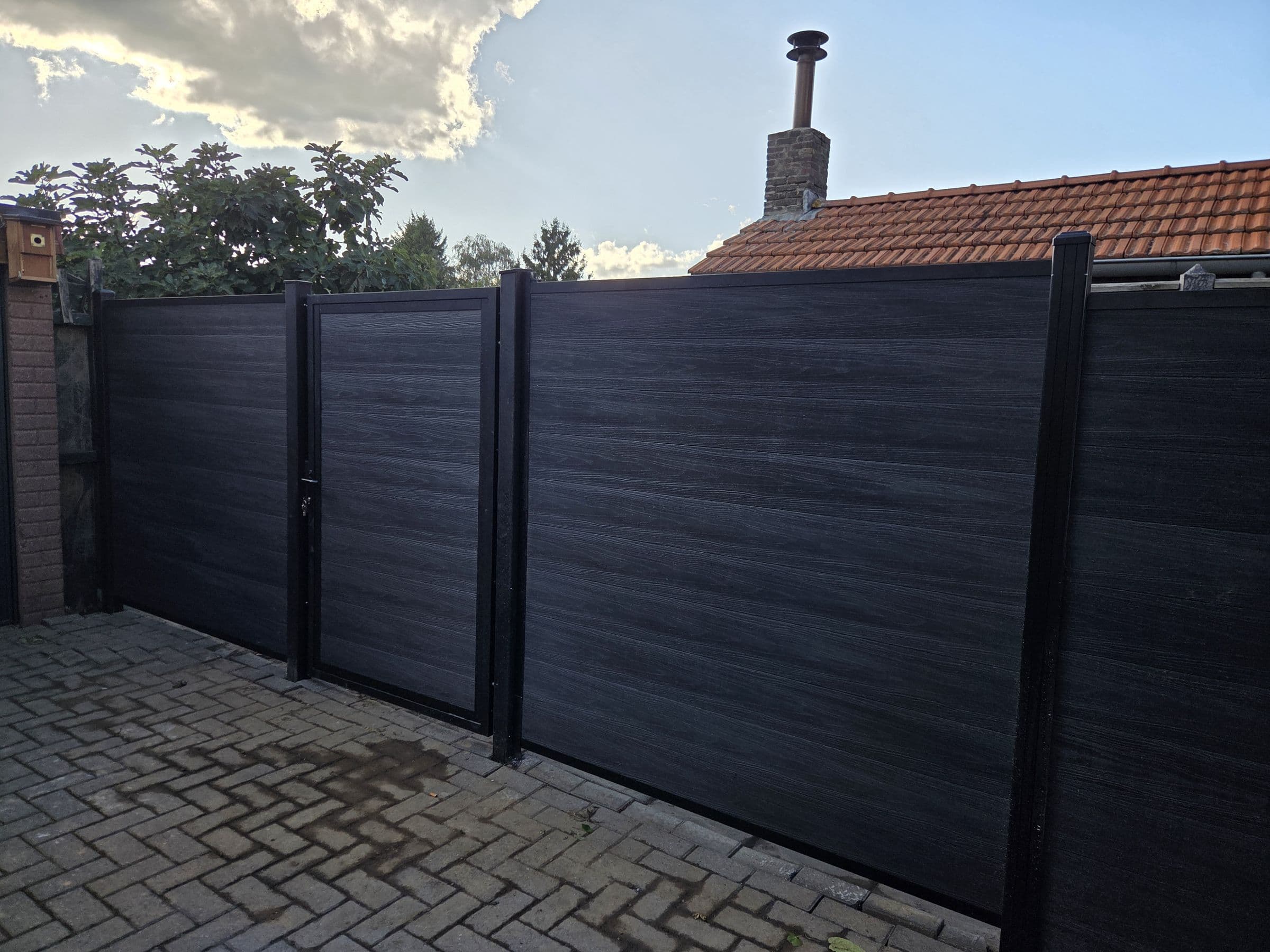
Send us a photo of your garden
A few photos, the rough length and your town already tell us a lot. Then you get a free quote, with no obligation.