Composite fencing, installed in Dutch Limburg
Composite fencing (composiet schutting) is a solid fence made of WPC boards, a mix of wood fibre and plastic that never needs stain or paint. ZuidHek installs it in wood-effect or anthracite between black aluminium slotted posts, on a concrete gravel board, in Geleen and across South Limburg. We set out every line with a string line and a laser.
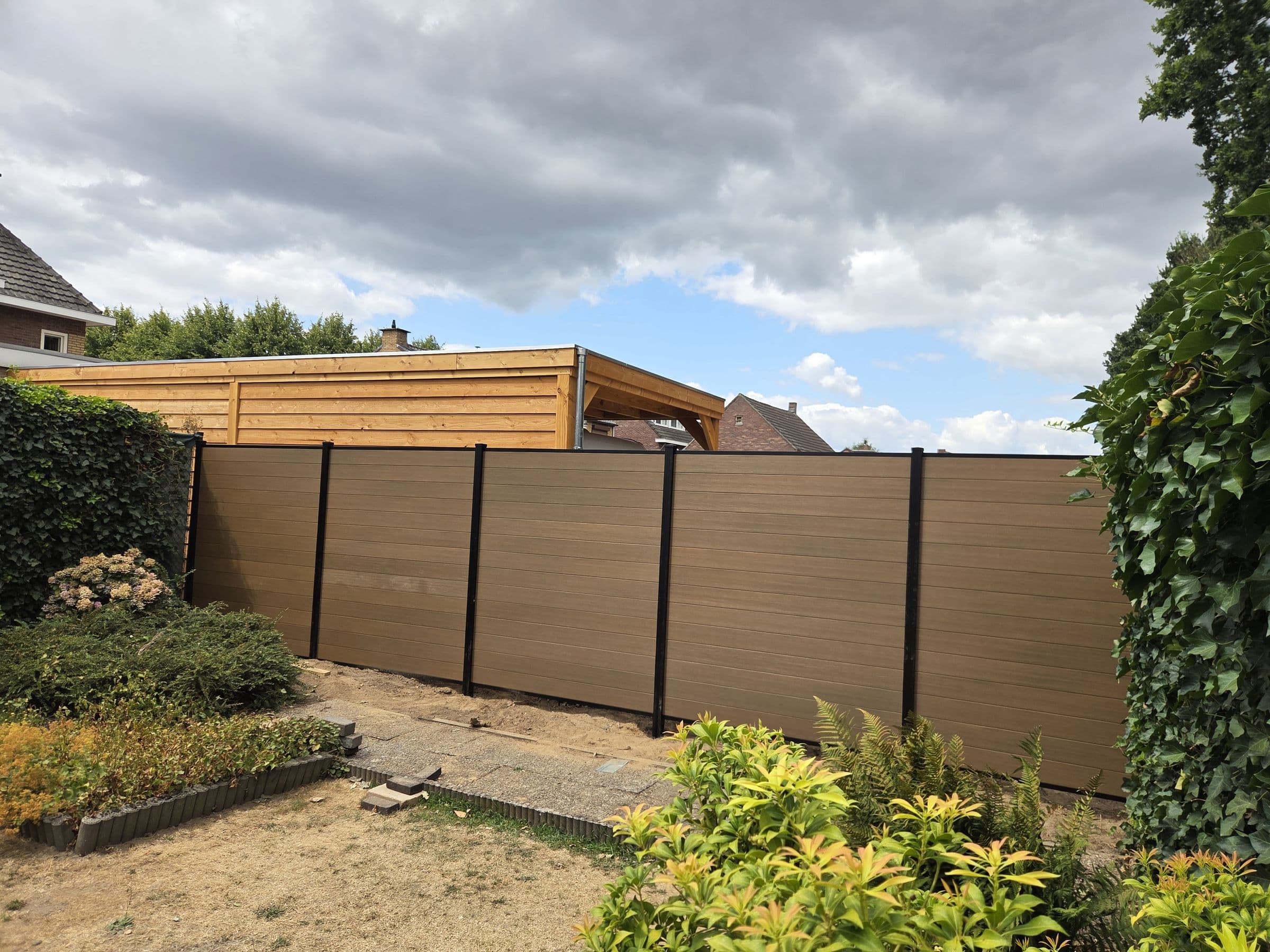
Choose composite if you want a solid fence that needs little maintenance. No stain, oil or paint is needed. Rinse it now and then with water and a soft brush to keep the boards clean. A wooden fence needs treatment every few years. Composite does not.
We build every composite fence the same way. Black aluminium slotted posts go into the ground at the right depth. A concrete gravel board goes between the posts, and we stack the boards on top of it, in the slots. This keeps the boards out of the wet ground and gives the bottom edge the same height along the whole length.
You choose between wood-effect, a brown colour with a wood grain, and anthracite, which looks clean next to dark window frames and grey paving. In our projects you can see how both colours look in a normal back garden.
Specifications
- Boards
- WPC (wood fibre and plastic) in wood-effect or anthracite. Co-extruded boards have an extra outer layer around the core that gives better protection against moisture, dirt, fading and UV light.
- Posts
- Black aluminium slotted posts of about 8×8 cm. A cap goes on top. We close any unused slot with a cover strip.
- Bottom
- Concrete gravel board between the posts, a few centimetres into the ground. Where the ground slopes or the load is heavy, a concrete footing.
- Assembly
- Boards stacked in the slot of the post. Aluminium U-channels hold the stack against the post. We leave room for the boards to expand.
- Post depth
- About one third of the post length in the ground. For a 2 m fence that is about 70 to 80 cm.
- Height
- Usually up to 2 m in the back garden and up to 1 m at the front without a permit. The exact rules and exceptions are in our guide to the rules.
- Maintenance
- No stain, oil or paint. Rinse now and then with water and a soft brush.
- Wood-effect
- Brown colour with a wood grain in the board. Blends in with plants and suits wood or natural stone in the garden. Gets less hot in the sun than anthracite.
- Anthracite
- Dark grey and clean-looking, good with anthracite window frames and grey tiles. In full sun a dark board gets noticeably warm and expands a little more.
- With matching gate
- A gate with the same board and colour in an aluminium frame, so the fence continues in one line.
How we install it
- 1
Setting out
We stretch a string line along the whole run and use the laser to set the height of every post and gravel board, also in a sloping garden.
- 2
Setting the posts
We drill the holes with an auger, set the posts in concrete at the right depth and make them level. The distance between the posts must match the length of the boards.
- 3
Fitting the gravel boards
The concrete gravel boards slide in between the posts, a few centimetres into the ground and at laser height.
- 4
Boards and finishing
We stack the boards with room to expand and fit the U-channels and caps. Then we check the line once more and clean up the work area.
Projects: Composite fencing
All projectsAnthracite fence along the pavementComposite, anthracite · Sept 2026 Anthracite fence at the front of a houseComposite, anthracite · Sept 2026 Wood-effect fence around a parking spaceComposite, wood-effect · Sept 2026 Anthracite fence behind a flower gardenComposite, anthracite · Aug 2026 Brown composite fence in a corner of the gardenComposite, wood-effect · Jul 2026 Wood-effect fence on the boundary with a meadowComposite, wood-effect · Jul 2026 Anthracite fence around a swimming pool in the morning sunComposite, anthracite · Jul 2026 Anthracite fence around a garden with a swimming poolComposite, anthracite · Jul 2026
Good to know
- Composite expands
- Composite expands more than wood in heat, about 1 mm per metre for a 40 °C temperature difference. That is why we leave room for movement. A fence fitted tightly on a cold day can bulge in summer.
- Dark colours get hot
- Anthracite looks clean, but in the afternoon sun the boards get hot to the touch and move more. If the fence is in the sun all day, wood-effect is often the calmer choice.
- Damage is repaired differently
- You cannot sand or paint away a deep scratch in composite as you can with wood. You can replace a board: the cap comes off and the boards come out from the top, including the ones above the damaged board.
- Higher price, less maintenance
- Composite costs more to buy than treated wood. On the other hand, you never need to sand, stain or paint it again. Compare the cost over the years, not only on the day you buy.
Further reading
Frequently asked questions
Is a composite fence maintenance-free?
Low-maintenance is the honest word. You do not need to stain, oil or paint a composite fence. Rinse the boards with water a few times a year and use a soft brush for dirt or green deposits. Do not use a pressure washer close to the boards. Wood needs treatment every few years.
What are the disadvantages of a composite fence?
Composite expands more than wood in heat, about 1 mm per metre for a 40 °C difference, so it must be installed with room to move. Dark colours get hot in the sun. It costs more to buy than treated wood, and a deep scratch is harder to repair. In return, it needs little maintenance.
How high can a composite fence be in the back garden?
In the back garden a boundary fence can usually be up to 2 m high without a permit, on a plot with a main building and behind the front of the house. At the front the limit is usually 1 m. Your municipality can set other rules, and listed buildings have stricter rules. If in doubt, use the permit check (Vergunningcheck) in the Omgevingsloket. If you rent, you also need written permission from your landlord or housing corporation.
How long does a composite fence last?
Suppliers often say 15 to 25 years for co-extruded composite, against about 10 to 15 years for treated softwood. These are estimates, not guarantees. The lifespan also depends on the posts, the gravel board and how straight the fence stands. A fence that leans pulls on the boards and wears out sooner.
Can a composite fence have concrete posts?
Yes, there are concrete slotted posts that composite boards fit into. We install composite on black aluminium slotted posts: they are slimmer and match wood-effect and anthracite. If you still want concrete posts, for example because the rest of the garden already has them, mention it when you ask for a quote.
Want us to look at your situation?
Send a few photos and the rough length on WhatsApp. You get a quote for your garden, free and with no obligation.
Your messageZuidHek · +31 6 13 87 10 16
Hi ZuidHek, I would like a quote for composite fencing. I'll send a few photos of the garden next.
When WhatsApp opens, send 2 or 3 photos of the situation. This helps us make a faster and more accurate quote.
This website does not store anything. Your message goes straight to WhatsApp.