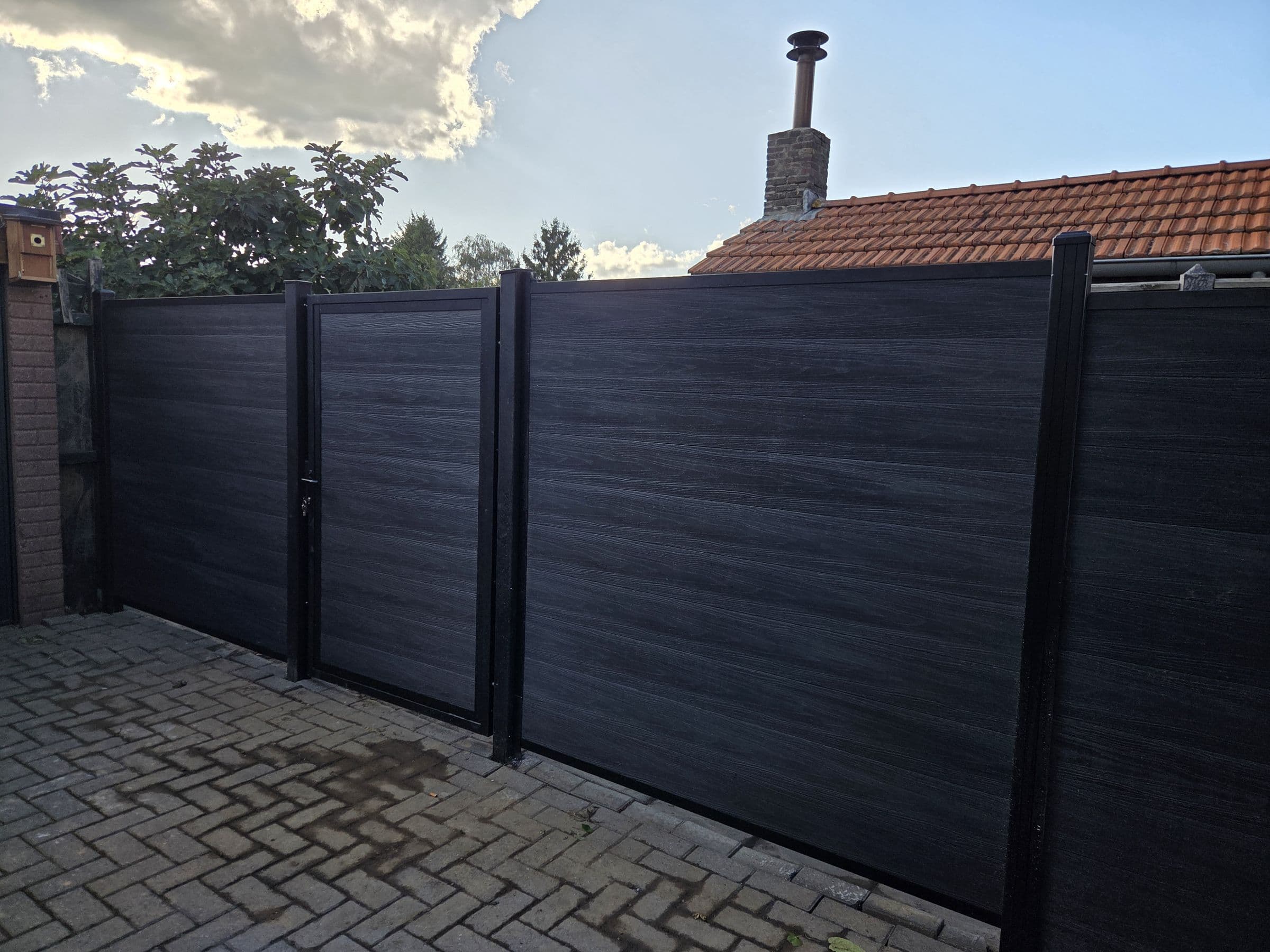
The five materials side by side
| Material | Look | Privacy | Maintenance | Strength | Watch out for |
|---|---|---|---|---|---|
| Composite | Wood-effect or plain anthracite | Closed | Low: water and a soft brush now and then | Good, with aluminium posts and a concrete gravel board | Expands in the heat; dark colours get hot |
| Wood | Natural; turns grey without treatment | Closed | Regular staining, oiling or painting | Depends on the posts and the installation | Can warp, crack and rot |
| Wood-and-concrete | Robust: concrete posts and concrete boards with wood in between | Closed | Treat the wood; the concrete needs hardly anything | Very sturdy and heavy | Heavy to install; the concrete is clearly visible |
| Twin wire mesh | Clean and open, steel panels | Low, unless with windscreen cloth or plants | Low | High, especially 8/6/8 | Cloth increases the wind load |
| Chain-link | Light and open | Low | Low; sometimes re-tensioning | Moderate; bends under pressure | Must be tensioned well |
We have left out prices on purpose. They depend more on length, height, ground and design than on the material alone. See our guide on getting a quote.
Composite: closed and low-maintenance
Composite is also called WPC: Wood Plastic Composite, a mix of wood fibre and plastic. With co-extrusion (co-extrusie), the core gets an extra outer layer that resists moisture, dirt, fading and UV light better.
The boards slide into an aluminium slotted post (sleufpaal): a post of about 8×8 cm with a slot that holds the boards. A cap (afdekkap) goes on top. A concrete gravel board (onderplaat) between the posts keeps the boards off the damp ground. Where the ground level changes, it also holds back soil.
- No stain, oil or paint needed. Rinsing it now and then with water and a soft brush is enough. So it is low-maintenance, not maintenance-free.
- An even colour and a straight line, in wood-effect or anthracite.
- No splinters.
The disadvantages of a composite fence:
- It expands in the heat. Suppliers work with about 1 mm per running metre for a temperature difference of 40 °C. So the installation must leave room for movement.
- Dark colours, such as anthracite, get hot to the touch in the sun.
- It costs more to buy than a wooden fence.
- A damaged board is hard to repair invisibly; usually you replace the board.
ZuidHek installs composite in wood-effect and anthracite, with black aluminium slotted posts and concrete gravel boards.
Wood: natural, with more maintenance
A wooden fence usually consists of garden screens (tuinschermen): ready-made panels, often 180×180 cm, between wooden or concrete posts. Pressure-treated softwood, such as spruce (vuren) or pine (grenen), is common. Hardwood is heavier and more expensive.
- Cheaper to buy, and a single screen is easy to replace.
- A natural look. Untreated wood turns grey over time.
- Needs regular maintenance: staining, oiling or painting, depending on the type of wood and your taste.
- Can warp, crack and eventually rot, especially where the wood touches the ground.
ZuidHek does not install wooden fences. We describe wood here as an alternative, so you can compare fairly.
Wood-and-concrete: heavy and sturdy
A wood-and-concrete fence (hout-beton) has concrete slotted posts with concrete gravel boards, and wooden screens or boards in between. A concrete post stands about one third of its length in the ground.
- Very sturdy and stands up well to wind.
- Concrete does not rot. The wood in between needs the same maintenance as a wooden fence.
- Heavy: installation needs more people and sometimes machines, and a narrow path to the garden makes it difficult.
- The concrete stays clearly visible. That does not suit every garden.
ZuidHek does not install wood-and-concrete or all-concrete fences. We do install concrete gravel boards and foundations under composite fences and mesh fencing.
Twin wire mesh: strong and open
Twin wire mesh (dubbelstaafmat) is a welded steel panel with two horizontal wires at each crossing. The numbers 6/5/6 and 8/6/8 are the wire thicknesses in millimetres: horizontal, vertical, horizontal. 8/6/8 is heavier and stiffer; for most gardens 6/5/6 is enough. The mesh openings are usually 200×50 mm.
- Strong and hard to push in, even by a dog or children playing.
- Little maintenance.
- Open: you keep the view and the light.
- Matching gates in the same colour.
- Without cloth or plants, it gives no privacy.
If you want more shelter, you can add windscreen cloth. This cloth catches much more wind than the open panel. Posts, fixings and foundations must be designed for that.
ZuidHek installs twin wire mesh with matching gates, with windscreen cloth if you want it.
Chain-link fencing: light and affordable
Chain-link fencing (gaashekwerk) is wire mesh from a roll. It is pulled tight between posts with straining wire (spandraad), a tensioned wire along the top and bottom, and fixed with binding wire (binddraad).
- An affordable way to fence a long length, for example around a property, a meadow or a vegetable plot.
- A light material, and it follows sloping ground more easily than stiff panels.
- Less stiff than twin wire mesh: it can bend under pressure.
- It must be tensioned well. Slack mesh soon starts to sag.
ZuidHek installs chain-link fencing with straining wire.
Which fence to choose
- You want a closed fence with little maintenance: composite, with a gravel board.
- You want privacy for as little money as possible and do not mind regular maintenance: wood.
- You want a heavy, wind-resistant fence and the look of concrete suits your garden: wood-and-concrete.
- You want a strong, open partition, for example for children or a dog: twin wire mesh, with a matching gate.
- You want to fence a long length affordably: chain-link.
- You want it open, but sheltered at times: twin wire mesh with windscreen cloth or climbing plants.
You can also combine materials: composite by the terrace, twin wire mesh or chain-link further down the garden.
Not sure about your situation?
Send a photo of the spot and your question on WhatsApp. We are happy to help, also if you do not know yet what you want installed.
Questions about this topic
What are the disadvantages of a composite fence?
Composite expands in the heat: about 1 mm per running metre for a 40 °C difference, according to suppliers. So the installation must leave room for movement. Dark colours such as anthracite get hot in the sun. It costs more to buy than wood. A damaged board is hard to repair invisibly; usually you replace it.
SourcesSupplier information: expansion of composite (buitenpaneel.nl, in Dutch)
How long does a composite fence last?
Suppliers give very different estimates: often 15 to 25 years, and some sellers say up to 50 years for co-extruded boards. These are sales figures, not guarantees. The real lifespan depends on the product, the sun, the installation and the maintenance. Strong posts and a gravel board help.
SourcesSupplier information: lifespan of a composite fence (schutting.nl, in Dutch)
Composite or wooden fence: which is better?
That depends on what matters to you. Composite needs little maintenance, does not splinter and keeps an even colour, but it costs more and expands in the heat. Wood is cheaper to buy and looks natural, but it needs regular staining or oiling and can warp or rot.
What is the difference between 6/5/6 and 8/6/8 twin wire mesh?
The numbers are wire thicknesses in millimetres: horizontal, vertical, horizontal. An 8/6/8 panel has thicker wires and is heavier and stiffer than 6/5/6. For most gardens and boundary fences, 6/5/6 is enough. Choose 8/6/8 where the fence has to take more. The mesh openings are usually 200×50 mm.
SourcesSupplier information: the difference between 6/5/6 and 8/6/8 (countrywood.nl, in Dutch)
Chain-link or twin wire mesh: what is the difference?
Chain-link is wire mesh from a roll, pulled tight with straining wire. It is light and affordable and follows sloping ground easily, but it can bend under pressure. Twin wire mesh consists of stiff, welded steel panels. It is stronger and neater, and more expensive. Without cloth or plants, both give little privacy.
Does ZuidHek also install wooden or wood-and-concrete fences?
No. ZuidHek installs composite fences, twin wire mesh and chain-link fencing, with gates, concrete gravel boards and foundations. We describe wood and wood-and-concrete in this guide as alternatives, so you can compare fairly. If you are unsure which material to choose, send photos of the spot and ask us what we would choose.
Sources
- Supplier information: expansion of composite (buitenpaneel.nl, in Dutch)buitenpaneel.nl
- Supplier information: lifespan of a composite fence (schutting.nl, in Dutch)schutting.nl
- Supplier information: the difference between 6/5/6 and 8/6/8 (countrywood.nl, in Dutch)countrywood.nl
- IPLO: permit-free boundary fences (in Dutch)iplo.nl
Last checked: 5 October 2026